

The AI Commerce Gap: Why Product Catalogs Fall Short
The limitations of traditional ecommerce websites in the age of AI shopping

For decades, ecommerce has been built around one type of shopper: humans.
Everything from websites and category pages to search filters and product listings was designed to help people browse, compare, and eventually decide what to buy. Shopping was a visual experience. Customers explored products, read descriptions, looked at photos, compared options, and made a choice.
But a new type of shopper is emerging: AI.
AI assistants are increasingly helping consumers discover, compare, and evaluate products. Instead of browsing dozens of pages, customers can simply ask:
What's the best pair of running shoes under $50?
Show me a lightweight waterproof jacket for hiking.
A waterproof backpack that fits a 16-inch laptop and works as a personal item on flights.
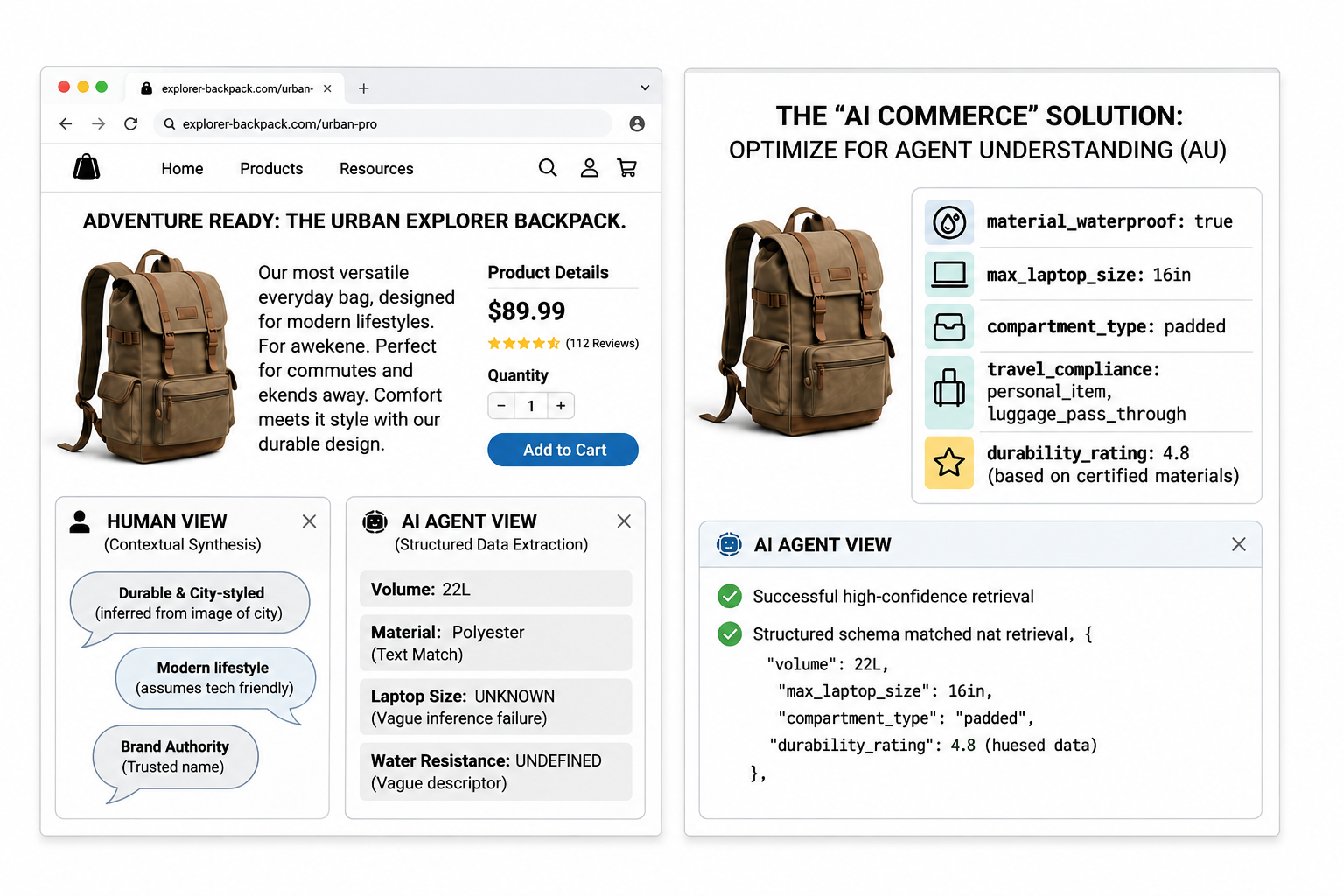
These questions sound simple for shoppers to ask, but they can be surprisingly hard for AI systems to answer. A shopper might ask an AI assistant for “a waterproof backpack that fits a 16-inch laptop and works as a personal item on flights”. The right product may already exist in a merchant’s catalog. But if waterproofing is only mentioned in an image, laptop size is buried in a bullet point, and travel compatibility is described vaguely as “great for everyday adventures”, AI may not confidently surface that product.
It's not that AI can't read product information. It's that the information it needs is often scattered, inconsistent, or missing altogether. As a result, AI often ends up with an incomplete understanding of the product it's trying to recommend. This is what we call the AI commerce gap.
Marketing Language Creates Friction
Product catalogs are often optimized for marketing rather than understanding. Consider these two product descriptions:
Our most versatile everyday backpack designed for modern lifestyles.
22L waterproof backpack with a padded 16-inch laptop compartment, luggage pass-through, and airline carry-on compatibility.
Both descriptions may appeal to a shopper, but the second one clearly communicates what the product actually is. Humans are remarkably good at filling in missing information. We can look at photos, understand branding, and make sense of phrases like “modern lifestyles”. AI struggles more when critical details are hidden behind broad claims or promotional copy. This doesn't mean marketing is bad. Storytelling remains an important part of commerce. The problem is that marketing language alone doesn't give AI enough information to confidently compare products, answer questions, or make recommendations.As AI becomes a larger part of the shopping journey, product information must do both: inspire humans and inform machines.
Information Is Often Scattered
Even when product information exists, it is rarely located in one place. A shopper looking for a carry-on suitcase might find dimensions on the specification tab, durability claims in customer reviews, warranty information in an FAQ, and material details buried in the product description. Humans naturally connect these dots, but AI has to find them first. This becomes especially difficult when information is inconsistent across products or entirely missing from the catalog.
For example, one merchant may describe a suitcase as "carry-on friendly" while another lists exact dimensions and a third provides no travel information at all. A human can work around these inconsistencies. AI often cannot.
The result is a fragmented understanding of products, making it harder to compare options and generate reliable recommendations.
The Next Generation of Commerce Infrastructure
Every major shift in technology has required new infrastructure. The internet required websites, mobile required apps, and social media required content and engagement. AI commerce needs infrastructure that helps AI understand products as easily as humans do. That doesn't necessarily mean rebuilding ecommerce from scratch. It means product data needs to be organized in a way that works beyond the traditional storefront. Product catalogs can no longer just power product pages. They also need to power AI search, product comparison, personalized recommendations, and conversational shopping experiences. That requires clearer product attributes, more consistent facts, richer context, and information that can travel across channels. The merchants that adapt early will have an advantage as AI becomes a larger part of the buying journey.
Looking Ahead
Every major shift in technology has required new infrastructure. The internet required websites; mobile required apps. AI commerce requires a new level of data maturity. In the past, we optimized for SEO (Search Engine Optimization) for web crawlers. Today, we must optimize for AI agent understanding. The next generation of commerce won't be defined by who has the largest catalog or the most traffic. It will be defined by who makes their products the easiest for an AI to interpret. Because in the age of AI, visibility isn't just about being online, it's about being understandable.